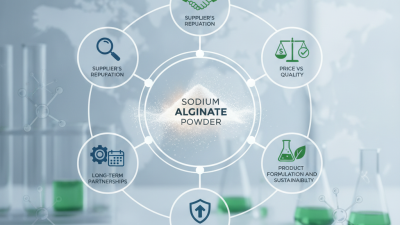
So, you're looking into China’s Sodium Alginate suppliers and manufacturers, huh? Well, this industry really spans quite a bit—everything from food and pharmaceuticals to textiles, cosmetics, and even lab work. But here’s the thing: when deciding who’s “best,” it’s not just about the name. You gotta think about whether they meet your specific needs—like consistency, proper documentation, and whether they can reliably deliver. For instance, a supplier that’s great for stabilizing drinks might not cut it if you need pharmaceutical standards.
Dr. Se-Kwon Kim, a renowned marine biotech researcher, once said, “Marine biotechnology should deliver value **while** respecting the marine environment.” That’s a good reminder that when you’re checking out seaweed-based producers, they should be transparent about where their seaweed comes from, how they extract the ingredients, and their environmental efforts. Responsible companies should be open about their sourcing, quality control measures, and eco-friendly practices.
A thorough review should cover details like viscosity, gel strength, pH levels, moisture, ash content, microbiological standards, and heavy metal testing. It’s smart to ask for recent Certificates of Analysis and get samples for yourself. Keep track of batch numbers and traceability—these little details matter a lot.
Now, some suppliers might lure you with low prices but offer limited technical support, while others have extensive documentation but charge a bit more. Neither option’s automatically better—it really depends on what you need and your experience level.
Make sure the supplier is clear about particle size, packaging, minimum order quantities, lead times, and their export experience. Visiting the factory or having an independent lab test some samples can reveal things that glossy brochures never show. Of course, for smaller buyers, testing every single batch might not be feasible, but doing a little homework always counts.
This guide aims to help you compare Chinese Sodium Alginate suppliers based on quality, application know-how, certifications, production capacity, and how responsive they are. Keep in mind—things change, and the info might not stay current forever. Always double-check before you sign on the dotted line!

Sodium alginate, identified by CAS 9005-38-3, is a polysaccharide extracted from brown seaweed. In food applications, it is recognized as E401 in the European Union and INS 401 under Codex references. JECFA lists alginic acid and its salts with an acceptable daily intake of “not specified,” when used according to good manufacturing practice. Regulatory status still depends on product category and national rules.
Market data shows steady industrial demand. Grand View Research valued the global alginate market at approximately USD 760.4 million in 2023. Its report forecasts a compound annual growth rate of about 5.5% from 2024 to 2030. Other market studies report different values. Definitions vary, so the figures require careful reading. Sodium alginate suppliers in China commonly serve food, pharmaceutical, textile, dental, and laboratory users. However, supplier selection should focus on evidence, not only price.
A food-grade manufacturer should provide specification sheets, batch traceability, microbial results, heavy-metal testing, and viscosity data. Viscosity often ranges from low to high grades, depending on concentration and testing temperature. Calcium ions can transform a sodium alginate solution into a firm gel, supporting fruit coatings, restructured foods, and controlled-release systems. Pharmaceutical processors may use it in wound dressings and oral formulations. Textile printers value its controlled thickening behavior. A practical audit should also check seaweed origin, moisture, ash, pH, and packaging integrity. Small details matter.
Sodium alginate is a water-soluble polysaccharide derived from brown algae. It is identified by CAS 9005-38-3 and is designated as food additive E401. The chart shows its recognized functional roles across major application areas; the values indicate the presence of a representative use, not market share or company performance.
Common functions include thickening, stabilizing, gel formation, film formation, encapsulation, and moisture control. Calcium ions can convert sodium alginate solutions into elastic calcium-alginate gels, supporting applications in food, pharmaceuticals, biotechnology, and medical materials.
When evaluating China-based sodium alginate suppliers and manufacturers, begin with measurable quality metrics rather than marketing claims. Sodium Alginate Powder should have a clearly stated viscosity, tested at a defined concentration, temperature, and spindle speed. Without these conditions, two viscosity figures cannot be compared fairly. A stable batch should also show consistent flow during mixing, with no unexpected lumps or gel strings.
Purity affects performance, especially in food, pharmaceutical, and technical formulations. Ask for an assay report, traceability records, and testing methods from an independent or qualified laboratory. Moisture deserves close attention. Excess water can increase clumping, shorten shelf life, and alter the supplied weight. A sealed sample may look dry, yet storage conditions can tell another story. Check the moisture result against the agreed specification for every batch.
pH influences compatibility and final product stability. Request the test medium and dilution ratio, because pH readings can shift with preparation. Particle size also matters. Fine powder disperses quickly, while larger particles may require stronger agitation. Request a sieve profile or particle-size distribution, not only the phrase “uniform powder.” A polished certificate is not proof of process control. Compare several batches, inspect packaging seals, and review how deviations are handled. Some suppliers provide excellent first samples but weaker repeat shipments. That risk deserves honest attention before purchase.
China’s sodium alginate manufacturing process begins with carefully selected brown seaweed. Producers wash the raw material to remove sand, salts, and attached organisms. The cleaned seaweed is then treated with an alkaline solution. This releases alginate from the plant’s cell walls. After extraction, filtration removes fibers and insoluble particles. Acidification may convert the liquid alginate into alginic acid. Sodium carbonate then changes it into sodium alginate. The solution is concentrated, dried, and milled into a fine powder.
Standardization requires more than checking color. Manufacturers test viscosity, moisture, pH, gel strength, ash, and particle size. Food and pharmaceutical grades also need microbiological testing and controlled heavy-metal limits. Batch records should connect the finished powder with its seaweed source and processing conditions. The process is not perfectly uniform. Seasonal seaweed changes can affect viscosity and the mannuronic-to-guluronic acid balance. A reliable supplier should explain how these variations are monitored, not hide them behind attractive certificates.
Tips: Request a recent certificate of analysis and compare it with an independent test. Check whether the supplier controls washing, filtration, drying, and packaging in-house. Ask about traceability, storage humidity, and retest policies. A clean-looking powder is not enough. Small differences may change thickening performance in real formulations. Suppliers and manufacturers should provide clear technical data, realistic specifications, and evidence that each batch meets the agreed standard.
Choosing among China’s sodium alginate suppliers requires more than comparing prices.
Food-grade material should offer stable viscosity, controlled moisture, clean microbiological results, and traceable raw materials. Suppliers should provide batch testing, allergen statements, and production records. Small details matter. A slight color change may affect a clear beverage or gel dessert.
Pharmaceutical-grade sodium alginate demands tighter control. Buyers should review identity testing, heavy metal limits, microbial standards, and documentation for each batch. Manufacturing areas, storage conditions, and change-control procedures also deserve attention. Alginate Oligosaccharide is not simply a lower-viscosity alginate. Its molecular profile and intended application require separate specifications, testing methods, and regulatory review.
Textile-grade material often focuses on viscosity consistency, dissolution speed, and paste performance.
A reliable supplier should explain how the product behaves during printing, washing, and drying. Industrial-grade requirements may include adhesive strength, suspension stability, and performance in paper, welding, or water-treatment processes. Technical data should match real operating conditions, not only laboratory figures.
A low quotation can look attractive. It may hide weaker testing or inconsistent batches. No supplier is perfect, so honest communication about limitations matters. Buyers should request samples, compare production lots, inspect certificates, and confirm whether the factory can maintain specifications at commercial volume. Supplier audits are useful, but they cannot replace independent verification.
Choosing China’s best sodium alginate suppliers requires more than comparing prices. The FAO’s The State of World Fisheries and Aquaculture 2024 reported about 36.9 million tonnes of aquatic plants produced globally in 2022. This scale supports strong raw-material availability, but it does not guarantee consistent quality. Ask for ISO 22000, HACCP, or FSSC 22000 certificates, then verify their scope, factory address, expiry date, and audit status. A certificate is evidence, not proof.
Capacity should be tested through records, not impressive brochures. Request annual output, current utilization, minimum batch size, and recent delivery schedules. A serious manufacturer can explain how seaweed moves through washing, extraction, filtration, drying, and packing. Review laboratory reports for viscosity, pH, moisture, ash, microbiological limits, and heavy metals. JECFA specifications provide a useful technical reference for food-grade alginate evaluation.
Traceability reveals daily discipline. Each lot should link back to the seaweed species, harvest area, receiving date, drying conditions, and production line. Ask for a mock recall record. It should identify affected cartons within hours, not days. If the facility also handles Sodium Caseinate, request allergen controls and documented line-cleaning validation. I would still sample several shipments. Suppliers can present perfect paperwork while actual viscosity varies between batches. That uncomfortable gap deserves attention.
Selecting China-based sodium alginate suppliers requires more than comparing quoted prices. In practical procurement, viscosity and purity determine whether a powder performs consistently.
Typical commercial grades range from 80 to 1,000 mPa·s. This broad range supports different textures, flow behaviors, and processing needs. Lower-viscosity material can disperse more easily in thin formulations. Higher-viscosity grades may create stronger thickening at modest dosage.
However, viscosity is meaningful only with test conditions attached. Ask for concentration, temperature, spindle, shear rate, and measurement time. A number without these details is incomplete. Small differences can become visible in a mixing tank.
Purity commonly falls between 90% and 99%, but the stated basis needs careful review. It may refer to assay, dry basis, or a supplier-defined specification.
Request a current certificate of analysis, batch number, moisture data, ash content, pH, and microbiological results where relevant. Reliable manufacturers should explain raw-material controls, lot traceability, packaging barriers, and storage limits.
For production trials, compare at least two batches under identical conditions. That test often reveals more than a polished datasheet.
Do not confuse sodium alginate with Sodium L-Aspartate; they serve different technical roles.
A useful supplier also discusses hydration time and temperature, not only headline purity. Some specifications look excellent on paper. They may still require adjustment during scale-up.
Clear documentation, responsive technical answers, and repeatable samples are stronger indicators of manufacturing reliability.
China’s leading sodium alginate suppliers should treat export compliance as a technical process, not a paperwork exercise. Codex lists sodium alginate as food additive INS 401, while the United States permits it under 21 CFR 184.1724. European shipments require compliance with Regulation (EC) No 1333/2008 and additive code E401. Buyers should request a specification sheet, certificate of analysis, allergen statement, origin details, and batch traceability records.
Documentation matters.
Packaging affects stability and landed cost. Common export packs use 25-kilogram kraft bags with polyethylene liners, placed on heat-treated pallets. The inner liner must resist moisture because alginate can form lumps during humid voyages. Vacuum packing may improve protection, but it can increase handling and material costs. Smaller bags suit laboratory users, while one-ton big bags reduce labor for industrial buyers. Packaging choices should match warehouse conditions, not only the supplier’s standard offer.
Cost comparisons should separate product price from total delivery cost. A 2024 Grand View Research report estimated the global alginate market at over one billion U.S. dollars, with continued growth linked to food, pharmaceutical, and industrial applications. Higher viscosity, controlled M/G ratios, tighter microbiological limits, and pharmaceutical documentation usually raise prices. Freight, inspection fees, tariffs, and minimum order quantities also matter. A low quotation may hide expensive testing or weak moisture protection. I have seen buyers overlook this detail. That mistake is understandable, but avoidable.
Sodium alginate is a polysaccharide extracted from brown seaweed. It is identified by CAS 9005-38-3. In the European Union, it is known as E401. Codex references list it as INS 401.
It may be used when product standards and good manufacturing practice are followed. JECFA lists the acceptable daily intake as “not specified.” This does not remove national requirements. Check the rules for the intended food category.
Food processors use it for thickening, coatings, and gel formation. Pharmaceutical processors may use it in oral products and wound dressings. Textile printers value its controlled thickening behavior. Dental and laboratory applications also exist.
Calcium ions can turn a sodium alginate solution into a firm gel. This supports fruit coatings and restructured foods. It may also support controlled-release systems. The final texture depends on concentration and processing conditions.
Commercial grades commonly range from 80 to 1,000 mPa·s. Low-viscosity powder may disperse more easily. High-viscosity grades can thicken more strongly at lower dosages. The number alone is incomplete.
Ask for concentration, temperature, spindle, shear rate, and measurement time. A sample tested at 25°C may behave differently at another temperature. Compare two batches under identical conditions. Small differences can appear in a mixing tank.
Request specification sheets, batch traceability, and current certificates of analysis. Useful data includes moisture, ash, pH, viscosity, microbes, and heavy metals. Verify certificate scope, factory address, expiry date, and audit status. Paperwork helps. It is not proof.
Request annual output, current utilization, minimum batch size, and recent delivery records. The supplier should explain washing, extraction, filtration, drying, and packing. Each lot should connect to seaweed origin, harvest area, and receiving date. Ask for a mock recall. It should locate affected cartons within hours, not days.
Sodium Alginate, identified by CAS 9005-38-3 and commonly recognized as food additive E401, is a versatile hydrocolloid used in food, pharmaceutical, textile, printing, paper, and other industrial applications. Its performance depends on key quality indicators such as viscosity, purity, moisture, pH, particle size, solubility, and gel-forming ability. Chinese manufacturers typically produce it through seaweed extraction, filtration, concentration, precipitation, drying, milling, and standardized blending. Different industries require different specifications: food and pharmaceutical grades emphasize safety, purity, and traceability, while textile and industrial grades may prioritize viscosity stability, processing performance, and cost efficiency.
When evaluating Chinese suppliers, international buyers should review certifications, production capacity, laboratory controls, batch consistency, raw-material sourcing, and complete traceability records. Common specifications may range from 80 to 1,000 mPa·s in viscosity and approximately 90% to 99% purity, depending on the application. Buyers should also compare export documentation, packaging formats, moisture protection, minimum order quantities, delivery terms, and total landed cost to select a reliable and suitable supplier.